
Support America’s National Ballet Company® DONATE NOW

Blog

SideBarre

Photo: Patrick Frenette.

SideBarre

It takes more than pliés to lift a ballet company to great heights. From dancers to conductors, teachers to makeup artists, this series features fascinating insight from ABT experts and an intimate look inside America’s National Ballet Company®. Take a spot at the SideBarre to get to know the incredible people behind each bourrée of American Ballet Theatre.

Posts in: ExploreView All Posts
December 2, 2025

ABT JKO School Alumni Profile:
Emilie Trauchessec

“A lot of people think that once you’re no longer a dancer, that part of you is gone. But the way I see it, it's still part of me.”

By Lauren Trossman

Emilie Trauchessec and Kent Andrews in <em>The Nutcracker</em>. Photo: Rosalie O'Connor Photography.
Emilie Trauchessec and Kent Andrews in The Nutcracker. Photo: Rosalie O'Connor Photography.

In 2019, after nine years as a student at the American Ballet Theatre Jacqueline Kennedy Onassis School, three ABT Summer Intensives, and a starring role as young Clara in Alexei Ratmansky’s The Nutcracker, Emilie Trauchessec decided to swap her pointe shoes for a textbook and enrolled at McGill University.  

Today, Emilie is a psychotherapist, specializing in providing mental health services for dancers and athletes, building on her professional ballet background to pave a career that supports other dancers. As we approach the 10th anniversary of The Nutcracker at Segerstrom Center for the Arts in California, SideBarre checked in with Emilie about this career transition, her relationship to dance today, and her time starring in The Nutcracker as a teenager. 

At age nine, Emilie joined the ABT JKO School Children’s Division, working her way through the School until her high school graduation. Emilie performed in The Nutcracker three times, as a Party Girl, Soldier, and, eventually, Clara. She looks back on those days fondly, particularly how much she loved getting to connect with the main Company members. Emilie shares that she remembers attending her first company rehearsal and being “so anxious,” but was immediately comforted as the dancers were “so nice and welcoming and all just wanted to help out.”  

Emilie Trauchessec in ABT JKO School Level 3 class. Photo: Rosalie O'Connor Photography.

Through her time at the ABT JKO School, Emilie found a family among her fellow dancers, relying on each other for support as they navigated the challenges that come with being a young dancer. This experience of communal support inspired Emilie’s decision to study psychology and sociology and go on to earn a Master of Social Work at Columbia University. “I saw a lot of people I was growing up with and dancing with struggling with their mental health,” Emilie shares, motivating her to pursue a career “making mental health care more accessible for the dance community.” 

Through her career as a therapist, Emilie has found new ways to integrate ballet into her life. This transition was not an easy one; she says, “I thought ‘who am I without dance?’ And so, when I took that step, at first, it was super scary. But then being able to continue to integrate dance into my life in different ways has been so eye opening and such a positive experience.” While dance is no longer her primary focus, she continues to take classes, see performances, and work with dancers as a therapist.  

As a Licensed Master Social Worker, Emilie works in a private practice, providing psychotherapy to a range of clients, with an emphasis on dancers and athletes. She sees the benefit of shared experience, having a personal understanding of high-pressure environments, performance anxiety, and injuries. Emilie is passionate about prioritizing mental health for professional dancers, telling us that mental health has traditionally been seen as taboo, but “now there’s a lot more discussion around it, a lot more resources at dance schools.” Emilie says that she thinks it’s important that these conversations are happening with young dancers, teaching kids from a young age to “be able to cope with the tough, competitive world they’re growing up in.” 

Emilie Trauchessec in <em>Interplay</em> by Jerome Robbins. Photo: Erin Baiano. .
Emilie Trauchessec in Interplay by Jerome Robbins. Photo: Erin Baiano. .

As her career progresses, Emilie’s dream is to open her own private practice focusing on dancers and athletes. She says, “because they have such unique experiences, I think a lot of dancers struggle to find therapists that they can connect with, because they feel like they need to explain a lot.”  

While her relationship with ballet has shifted over the years, Emilie has found the change to be positive. Working with dancers in a new way has helped her rediscover her love of ballet and help other dancers navigate the stresses of the industry. She says, “a lot of people think that once you’re no longer a dancer, that part of you is gone. But the way I see it, it’s still part of me. I think of it not as letting something go but finding a new way to integrate it into your life.” 

The writer, Lauren Trossman, is an ABT Press Intern for Fall 2025.

October 13, 2025

Faculty Profile: Karilyn Ashley Surratt

By Lauren Trossman

Karilyn Ashley Surratt. Photo: Emma Zordan. .

“Education is freedom, and the more you know, the more free you can be.”

As a middle-schooler in Missouri, Karilyn Ashley Surratt found a flyer at her local dance studio advertising a summer ballet intensive in New York City. Though her family decided that she was too young at the time for a summer in the city, years later Karilyn rediscovered that same flyer for American Ballet Theatre, still in a box at her mother’s house. Recalling this childhood dream, Karilyn decided to pursue a career in dance education, with the help of ABT. Since then, Karilyn has completed ABT’s National Teaching Curriculum, the ABT/NYU Master’s Degree, and is now a faculty member at the American Ballet Theatre Jacqueline Kennedy Onassis School.

SideBarre spoke with Karilyn about her journey to ABT, her philosophy around teaching and arts education, and her experiences as a Black and Native American woman in the performing arts. Dance has played a crucial role in Karilyn’s life, saying that dance gave her “a sense of embodiment, that helped me put myself together and understand my whole self, so that I was not afraid to speak.”

Currently, Karilyn is on faculty at the ABT JKO School Children’s Division, in addition to teaching college classes at Pace University in tap and dance history, and tap dance at the Academy at Steps on Broadway. She is also in the inaugural cohort of the Ailey Horton Teacher Training program. After a long career performing in renowned dance and musical theatre institutions such as the Rockettes and The Muny, Karilyn is now focusing her career on education. To Karilyn, dance education is “the ultimate practice of freedom,” believing that “it re-embodies your physical self, your spiritual, mental, and emotional selves.”

Karilyn feels that as an educator it is her role to create possibilities for her students. She thinks it is “really important as teachers that we never limit our students, because we limit ourselves when we limit our students.” Karilyn emphasizes the reciprocal nature of teaching; she says, “you have to recognize that your students are experts in their experience and so, at whatever age they are at, you can always be learning from them.”

As both a performer and teacher, Karilyn sees her cultural background as an inherently important component of her practice: “I’m a dancer who happens to be Native American and Black and that is a part of the artistry.” Her background informs her teaching style, as she comes from “a family of teachers,” and was raised in her family’s tradition of passing on ancestral knowledge.

Karilyn holds the honor of being the first Native American Rockette. When asked how she feels about this title, she says that it means more to her now than it did at the time, and, in fact, she did not even know that she was the first until her final year with the company. While she always included her Indigenous background in her press materials, it was often overlooked, and she feels that this was a missed opportunity, especially in her time on tour; Karilyn is passionate about community outreach and advocacy and laments the lost chance to connect with Native American groups throughout the country.

As a performer with mixed ancestry, she has felt tokenized by productions as “ethnically ambiguous,” and felt her offstage skills as a dance captain and assistant choreographer were underutilized for the sake of onstage diversity. While performing as a Rockette, Karilyn was at times provided with nude tights and costumes that did not match her skin tone. However, she feels that there have been some improvements over the years, especially with inclusive costuming, and continues to have hope that productions will fully appreciate the wide skill sets of their talent, regardless of skin color.

Ultimately, Karilyn feels that her role as an educator and a role model to younger performers, especially young women of color is both a great honor and a great responsibility. In teaching dance history to her college students, she is sure to always emphasize her own history of teachers, instilling a sense of legacy in her students. She says, “I want to be true to the legacy that has been instilled in me from my teachers, from their teachers, and from their teachers.”

Whether her classes are filled with young children in their first dance class or college students on the cusp of a professional career, Karilyn wants her students to know that the legacy they carry through dance is very valuable—“it’s valuable to them as an individual, it’s valuable to their families, and it’s valuable to society and culture at large.”

The writer, Lauren Trossman, is an ABT Press Intern for Fall 2025.

Brady Farrar. Photo: Ken Osabon.
Posted In
Explore
July 22, 2024

Brady Farrar's Original Choreography

By Paige Shea

A new choreographic force is rising at American Ballet Theatre, and, this time, it’s one of ABT Studio Company’s own dancers.

Brady Farrar, a member of ABT Studio Company since 2022, recently premiered his original choreographic work Night Falls – a pas de deux set to Frédéric Chopin’s Nocturne No. 19 in E Minor No. 1. – at The Joyce Theater with ABT Studio Company.

The Joyce Theater engagement also featured another one of Brady’s original works titled Flight of the Bumblebee, a challenging and rapid solo for a male dancer, set to the iconic Nikolai Rimsky-Korsakov score.

Brady was overjoyed when his pieces were picked for ABT Studio Company to perform, as it was the first time his choreography was danced in a Company program.

“It gave me more confidence and reassurance that I’m doing something right, which in turn makes me less afraid to express my feelings authentically,” he said.

Kyra Coco and Alejandro Valera Outlaw in <em>Night Falls</em>. Photo: Rosalie O’Connor.
Kyra Coco and Alejandro Valera Outlaw in Night Falls. Photo: Rosalie O’Connor.

This Summer, Night Falls will be featured at the BAAND Together Dance Festival, part of Lincoln Center’s Summer for the City program. BAAND features pay-what-you-want performances from New York City’s most prominent dance companies: Ballet Hispánico, Alvin Ailey American Dance Theater, American Ballet Theatre, New York City Ballet, and Dance Theatre of Harlem.

When Brady heard that Night Falls was chosen for BAAND, he was speechless.

“It was a milestone moment for me,” he said. “With every piece of my choreography that I showcase, there is some self-doubt, but for my work to be recognized and licensed by my dream company, it gives me even more inspiration to push the boundary of what I can do.”

For Brady, original choreography has been a part of his dance journey since the early days.

Since he was 16 years old, Brady has been choreographing works for dance schools to use for showcases or competitions. His knowledge of the “choreographic process” came from his dance teachers, Victor Smalley and Angel Armas, who he accompanied on choreography bookings.

Brady said that his own choreographic process begins with the musical score. “Picking music that takes the audience on a journey is important. I try to match the steps to the music, so it looks as if the dancer is completely embodying what the musician is playing,” he explained.

Brady Farrar in <em>Flight of the Bumblebee</em>. Photo: Rosalie O’Connor.
Brady Farrar in Flight of the Bumblebee. Photo: Rosalie O’Connor.

For Flight of the Bumblebee, Brady tried to “make the movements frantic and fast, to resemble what a bee would look like during flight.” He called the solo his “playful interpretation” of the Rimsky-Korsakov score.

For Night Falls, he was inspired by Chopin’s Nocturne No. 19 and how it “sets the tone of an intimate setting between two characters.”

“In my head,” said Brady, “the pas de deux is a representation of what happens when your day starts to slow down, the tranquil few hours from dusk to dark. As the sun sets, and night falls, how does the light change affect the mood and energy of oneself.”

For Brady, working with ABT Studio Company and teaching them his choreography was “something very special,” as he loves to see his peers’ unique interpretations of his work.

However, for BAAND, Brady was required to teach members of the main Company his choreography: Principal Dancers Thomas Forster and Chloe Misseldine, Soloist SunMi Park, and corps de ballet member Joseph Markey. Although he was nervous at first, he soon became inspired by their artistry.

“Their work ethic and desire to perfect each movement is very inspiring; I loved being able to see how professionals learn and pick up choreography,” said Brady. “They each have their own beautiful ways of hearing the music and executing the steps. Every time I step into a rehearsal with them, I am in awe.”

For Brady, having his original work chosen by ABT is only the beginning of his journey.

“It shows me that the future can be bright, and that there’s nothing to be afraid of.”

"For my work to be recognized and licensed by my dream company, it gives me even more inspiration to push the boundary of what I can do."

- Brady Farrar

The writer, Paige Shea, was an ABT Press Intern for Summer 2024.

Posted In
Explore
July 15, 2024

Echoes of Mexico

Unveiling the Musical Tapestry of Like Water for Chocolate

By Jackeline Fernandes

“Como agua para chocolate” is a Mexican idiom: translating to “like water for chocolate” in English, it essentially means “your emotions are in danger of boiling over,” referring to the repetitive process of bringing water to the brink of boiling before it can be used to make hot chocolate. Inspired by Laura Esquivel’s novel of the same name, the title phrase of Christopher Wheeldon’s full-length ballet, Like Water for Chocolate, alludes to the intense emotions simmering just beneath the surface in a tale of family saga and forbidden love set on a Mexican ranch during the Mexican Revolution. In this modern classic of magical realism, cooking and the kitchen’s heat suffuse the production, transforming rising passions into balletic movement set to music of a distinctly Mexican essence.

When composer Joby Talbot undertook the monumental task of scoring Like Water for Chocolate, his goal was clear: to infuse the score with a “DNA” of Mexican sound, rather than merely imitating it. Just as Mexican cuisine is rich and varied, Talbot’s score is seasoned with various rhythms from traditional Latin dances to trace the emotional turmoil of the lovesick central character, Tita, and the dramatic influence her impassioned cooking has on those around her.

In Act I, Tita prepares a dish of quail drizzled in rose petal sauce to the slow tempo of a danzón, a sensual dance rhythm that originated in Cuba at the end of the 19th century and later spread to Mexico. This amorous musical tone parallels Tita’s physical desire for her neighbor, Pedro, which manifests as an aphrodisiac in her cooking and consequently has an erotic effect on her sister, Gertrudis.

In another scene, alongside a climactic encounter between Tita and Pedro, Talbot recreated a sentimental petenera, one of the most melancholic and romantic styles of flamenco music. The origins of the petenera are older, dating back to the 17th century with ties to the zarabandas, another dance form popularized in Spain and the Spanish colonies.

Catherine Hurlin in Christopher Wheeldon’s <em>Like Water for Chocolate</em>. Photo: Marty Sohl.
Catherine Hurlin in Christopher Wheeldon’s Like Water for Chocolate. Photo: Marty Sohl.

The joropo, a much livelier Latin rhythm, provides a festive melody to which the troops commanded by Gertrudis energetically dance around a fire at the conclusion of Act II. A grand mixture of African, Indigenous, and European roots, the joropo is a traditional couple’s dance from Venezuela characterized by quick turns and jaunty footwork. According to Mexican conductor and music consultant Alondra de la Parra, Talbot’s musical arrangement for this scene aligns more with cumbia, known for its percussion-heavy, upbeat rhythm with Afro-Colombian roots.

While the blend of diverse Latin rhythms in Talbot’s score brings the characters’ earthly passions to life onstage, the mystical fusion of pre-Hispanic instruments with the orchestra introduces a new musical texture that embodies the essence of magical realism. Playing an indispensable role in the compositional process, de la Parra suggested incorporating the ocarina, a type of Aztec ceramic flute that lends the work a deep, ethereal quality reminiscent of birdsong. The percussion section of the orchestra expanded greatly under de la Parra’s guidance, with the inclusion of two types of Aztec drums—the teponaztli and the huéhuetl—as well as the marimba, featured in a challenging solo piece. Talbot’s complex yet whimsical compositions for the harps further amplify the thread of magical realism that reverberates throughout the work.

Tomás Barreiro in Christopher Wheeldon’s <em>Like Water for Chocolate</em>. Photo: Emma Zordan.
Tomás Barreiro in Christopher Wheeldon’s Like Water for Chocolate. Photo: Emma Zordan.

The main characters in the ballet are meaningfully tied to specific instruments in the composition, akin to a leitmotif: Tita with the delicate ocarina, Nacha with the warm cedar flute, Mama Elena with the tempestuous wooden rattles and chimes, and Pedro with the sultry guitar. Perhaps at the core of this entrancing whirl of sound is the guitar, strummed by Mexican musician Tomás Barreiro to the beat of Mexican sones and other Latin rhythms, both as a solo performance onstage and in the orchestra pit.

For the final pas de deux between Tita and Pedro, Talbot turned to an unconventional musical source, rarely found in the classical ballet repertoire: the human voice. Composed for a mezzo soprano, Talbot’s vocal piece features Spanish lyrics from the 1957 poem “Piedra del Sol,” or “Sunstone,” by Mexican Nobel Laureate Octavio Paz. The soaring soprano section brings the passionate tale of Like Water for Chocolate to a close, delivering a powerful performance about the cyclical nature of time and the transformative power of love, reserved only for those who recognize its constant return.


Sources:

Azar Boldo, Lázaro. “A Well-Seasoned Composition…” Program for Christopher Wheeldon’s Like Water for Chocolate, London, The Royal Ballet, 2022.

Royal Ballet and Opera. “Insights: Like Water for Chocolate – Music and Design.” YouTube, 27 May 2022, https://www.youtube.com/watch?v=KrWsYo8fU9g.


The writer, Jackeline Fernandes, was an ABT Press Intern for Summer 2024.

Posted In
Explore
September 29, 2023

From Classic Storybook Ballet to High School Teen Comedy:
Homages and Adaptations of Shakespeare’s A Midsummer Night’s Dream Through the Years.
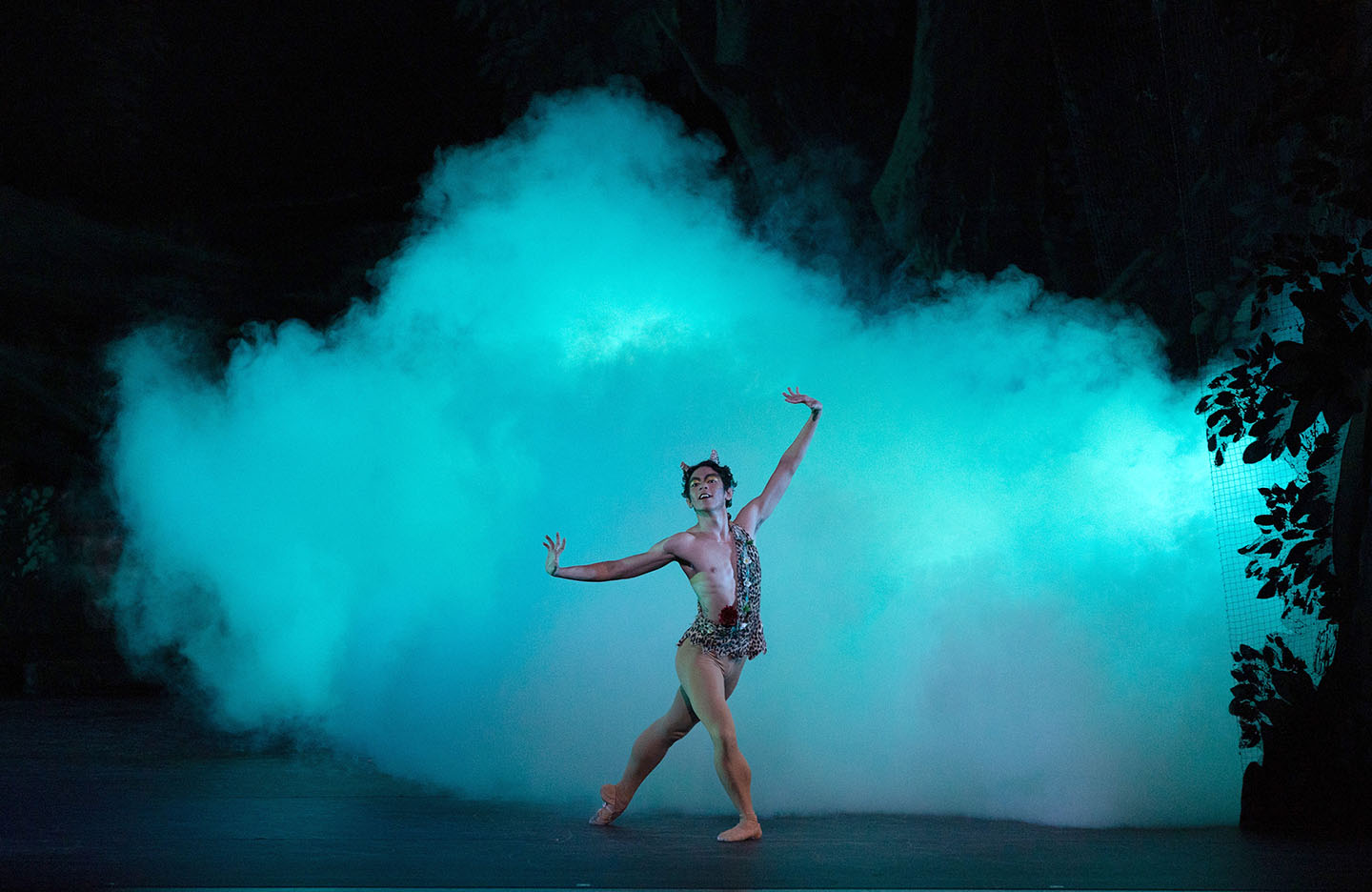
Elwince Magbitang as Puck in <em>The Dream</em>. Photo: Rosalie O’Connor.
Elwince Magbitang as Puck in The Dream. Photo: Rosalie O’Connor.

Returning for a second year in a row, Frederick Ashton’s The Dream retells Shakespeare’s classic comedy, A Midsummer Night’s Dream, through the scope of ballet—a mystical journey through the forest filled with fairies, mischief, and entanglements of the heart.  

The beloved Shakespeare tale has seen many transformations throughout time, transporting the characters from Ancient Greece to Victorian England and from the stage to screen and back again. Here are seven retellings of Shakespeare’s comedy of errors, ranging from 1980s rock operas to early 2000s teen comedies.  

Swingin’ the Dream (1939):
An almost-forgotten jazz and swing musical from the Golden Age of Broadway

With a stacked bill of America’s most famous Black artists at the time– including Louis Armstrong, Maxine Sullivan, and Bud Freeman – the creators were ready for their jazz and swing rendition of Shakespeare’s comedy to be a great success. Also joining the impressive credits was Agnes de Mille, a renowned choreographer who choreographed Rodgers and Hammerstein’s Oklahoma!, in addition to several ballets for New York City Ballet and American Ballet Theatre.  

Though there was incredible talent involved in the production, Swingin’ the Dream proved to be a complete flop. Premiering in 1939, the musical closed after only 13 performances, and no musical recording or complete copy of the script survived.  

The Dream (1964):
Frederick Ashton’s storybook ballet, returning for performances by American Ballet Theatre this Fall

Returning for ABT’s 2023 Fall season, Frederick Ashton’s retelling of Shakespeare’s A Midsummer Night’s Dream beguiles audiences as his lush, lively characters tangle themselves in love and mischief deep within a magical forest in Victorian England. This happy ode to the illusory nature of love is set to a spellbinding score by Felix Mendelssohn and arranged by John Lanchbery with sets and costumes by David Walker and lighting by John B. Read. 

Premiered by The Royal Ballet in 1964, Ashton’s ballet “contains some of the most delightful choreography—intricate, funny, plush, and, at times, extraordinarily sensual—ever made.” (The New Yorker 

Labyrinth (1986):
A 1980s cult classic homage with David Bowie

Described by The Atlantic as a “Bowie rock opera,” Jim Henson’s fantasy feature was received critically in 1986 – today, it’s a beloved cult classic. From the creator of the Muppets, Henson’s movie sees a 16-year-old Jennifer Connelly as Sarah exploring the winding labyrinth just like Shakespeare’s characters in A Midsummer Night’s Dream 

At the heart of the fairytale Labyrinth is the Goblin King Jareth, played by the genre-defining David Bowie. Bowie is also credited for the synth-electronic score, which uses his iconic sound aesthetics to complement the movie’s surrealist tale of knights, monsters, and coming of age.  

The Sandman Issue #19, “A Midsummer Night’s Dream” (1990):
Author Neil Gaiman’s DC Comic series turned hit Netflix

Neil Gaiman, author of Coraline, Good Omens, and American Gods, created the celebrated DC Comic The Sandman alongside artists Sam Kieth and Mike Dringenberg, which ran for 75 issues from 1989-1996. The comic series centers around Dream of the Endless, who rules over the Realm of Dreams. His siblings, known as the Endless, take on other physical personifications such as Destiny, Desire, and Despair.  

The Sandman Issue #19 depicts the very first 16th century staging of Shakespeare’s A Midsummer Night’s Dream, formed in creative partnership with Dream. A core issue of the series, #19 received a World Fantasy Award for short fiction in 1991. Now, The Sandman has been brought to life on the screen by Netflix as a television series, bringing in more than 1 billion minutes (about 1,901 and a half years) of viewing on the streaming service in its opening weekend.  

Mickey Mouse Works Episode #11 (1999):
Disney takes on the Shakespeare classic

Arguably the most popular cartoon character in history, Mickey Mouse stars in a retelling of A Midsummer Night’s Dream in Disney’s popular cartoon, Mickey Mouse Works. Alongside Mickey are fellow members of the Clubhouse like Minnie Mouse and Donald Duck. Goofy predictably, and hilariously, plays Puck.  

Running from 1999-2001, this short-lived cartoon series was beloved by many audiences for its ode to the Golden Age of Disney. Each episode featured a series of shorts of varying lengths, using animation and art styles from the company’s 1950s cartoons. Mickey Mouse Works was later incorporated into House of Mouse, which continued to run until 2003.  

A Midsummer Night’s Dream (1999):
Michelle Pfeiffer and Stanley Tucci transport the tale to 19th century Tuscany

Among the handful of movie adaptations, Michael Hoffman’s A Midsummer Night’s Dream stands out for its star-studded cast and faithfulness to the original script. Despite relocating the tale from Ancient Greece to the 19th century Italian countryside, the 1999 film keeps its heart in Shakespeare’s iambic pentameter.  

Hoffman’s film was answered with a lukewarm critical reception, but it dazzles nonetheless with its gauzy romanticism and big-name celebrities playing leading roles. Michelle Pfeiffer is a stunning Titania; Christian Bale practices his ‘rich kid’ persona for The Dark Knight as Demetrius, and Stanely Tucci is a mischievous Puck. Though it was not lacking in celebrity, the film is often lumped in by critics with the high-volume of 1990s Shakespeare movie adaptations.  

Get Over It (2001):
Turning Shakespeare from high school curriculum into high school comedy

The late 1990s should be considered the era of classics-turned-high school flick: Clueless is a valley girl version of Jane Austen’s Emma; 10 Things I Hate About You adapts Shakespeare’s Taming of the Shrew. The high school students, who probably read these classic stories in their English classes, were now the characters of convoluted love stories and comedies of error.  

Get Over It, premiering in 2001, takes this trend into the new millennium with early 2000s starlet Kirsten Dunst. Loosely based on Shakespeare’s play, the film spins A Midsummer Night’s Dream into a charming high school comedy where the students, entangled in their own drama, are involved in the school musical, A Midsummer Night’s Rockin’ Eve 

From stage to screen to page, each iteration of Shakespeare’s A Midsummer Night’s Dream – a magical tale of whimsy and entanglements of the heart – continues to enchant audiences.  

The writer, Lucy Kudlinksi, is the ABT Press Intern for Fall 2023.